Bibliography:
"Galileo Galilei". Wikipedia. N.p., 2016. Web. 19 Aug. 2016.
"Who Was Galileo Galilei? - Universe Today". Universe Today. N.p., 2015. Web. 20 Aug. 2016.
"Assess-Limitations Of Models". Scribd. N.p., 2016. Web. 23 Aug. 2016.
"BBC - GCSE Bitesize: Observing The Universe". Bbc.co.uk. N.p., 2016. Web. 23 Aug. 2016.
"Galileo Galilei Tide Theory". Mpg.de. N.p., 2016. Web. 23 Aug. 2016.
Tuesday, 23 August 2016

Diary entry 5
Dear Diary,
My model of the universe has limitations during its development. Although I did produce one of the best telescopes for observational use and theory making, it is nothing compared to technology today. Today, humans have created many mathematical advancements regarding the universe, including formulas to calculate almost anything. If this mathematics was available during my era, my tides theory would not be incorrect, because the theory would not exist as I would use mathematical reasoning to prove it isn't correct, and thus not publish the theory. Many advancements to telescopes have also been made, including more magnifications, allowing for observation of further stars in the universe. A notable advancement is that of spacecraft, which allow for travel to space itself; a remarkable pleasure which would have put geocentric beliefs to a rest.
If this technology was available back then, my theories would be much more accurate and correct.
My model of the universe has limitations during its development. Although I did produce one of the best telescopes for observational use and theory making, it is nothing compared to technology today. Today, humans have created many mathematical advancements regarding the universe, including formulas to calculate almost anything. If this mathematics was available during my era, my tides theory would not be incorrect, because the theory would not exist as I would use mathematical reasoning to prove it isn't correct, and thus not publish the theory. Many advancements to telescopes have also been made, including more magnifications, allowing for observation of further stars in the universe. A notable advancement is that of spacecraft, which allow for travel to space itself; a remarkable pleasure which would have put geocentric beliefs to a rest.
If this technology was available back then, my theories would be much more accurate and correct.
Diary entry 4
Dear Diary,
As stated in my last diary entry, the current universe model is that of a heliocentric one; the same as mine. My model and the current universe model are quite alike, however, there are some inaccuracies and incorrect information about my one. These inaccuracies come from the lack of advanced equipment like today's equipment. My observations and theories were based off evidence I collected from this telescope I pioneered myself:

As stated above, I do have incorrect information that is present in my model. I believed that the tides were a direct result of the Earth's inconsistent motion around the sun. Although this was incorrect, the earth still did rotate around the on its axis, whilst orbiting the sun, which was correct.
As stated in my last diary entry, the current universe model is that of a heliocentric one; the same as mine. My model and the current universe model are quite alike, however, there are some inaccuracies and incorrect information about my one. These inaccuracies come from the lack of advanced equipment like today's equipment. My observations and theories were based off evidence I collected from this telescope I pioneered myself:
As stated above, I do have incorrect information that is present in my model. I believed that the tides were a direct result of the Earth's inconsistent motion around the sun. Although this was incorrect, the earth still did rotate around the on its axis, whilst orbiting the sun, which was correct.
Diary entry 3
Dear Diary,
I am writing this about 430 years after my last.
Recent discoveries of the universe have come out, along with new theories. These new theories are backed up with better evidence, as these evidences are obtained through higher tier technology. Here it is:

As you can see, the model closely resembles mine, in fact, it is based off my model of the universe. The current universe model follows the heliocentric theory. My theories of the Venus phases and Jupiter moons have also contributed to the modern universe model.
I am writing this about 430 years after my last.
Recent discoveries of the universe have come out, along with new theories. These new theories are backed up with better evidence, as these evidences are obtained through higher tier technology. Here it is:
As you can see, the model closely resembles mine, in fact, it is based off my model of the universe. The current universe model follows the heliocentric theory. My theories of the Venus phases and Jupiter moons have also contributed to the modern universe model.
Diary entry 2
Dear Diary,
My interest in the universe has always been of great magnitude. During my discoveries and researches, I have utilized the telescope as a basis of my evidence and observation. I have also created my own telescopes, better grade telescopes for scientific use. With the usage of this equipment and my extensive observation, analysis and scientific method, I have come up with a model of how the universe looks like, which I believe is correct.


My model is heavily based off the Copernicus model, a heliocentric model. In my model, the sun is in the middle, and the planets orbit around it.
My interest in the universe has always been of great magnitude. During my discoveries and researches, I have utilized the telescope as a basis of my evidence and observation. I have also created my own telescopes, better grade telescopes for scientific use. With the usage of this equipment and my extensive observation, analysis and scientific method, I have come up with a model of how the universe looks like, which I believe is correct.
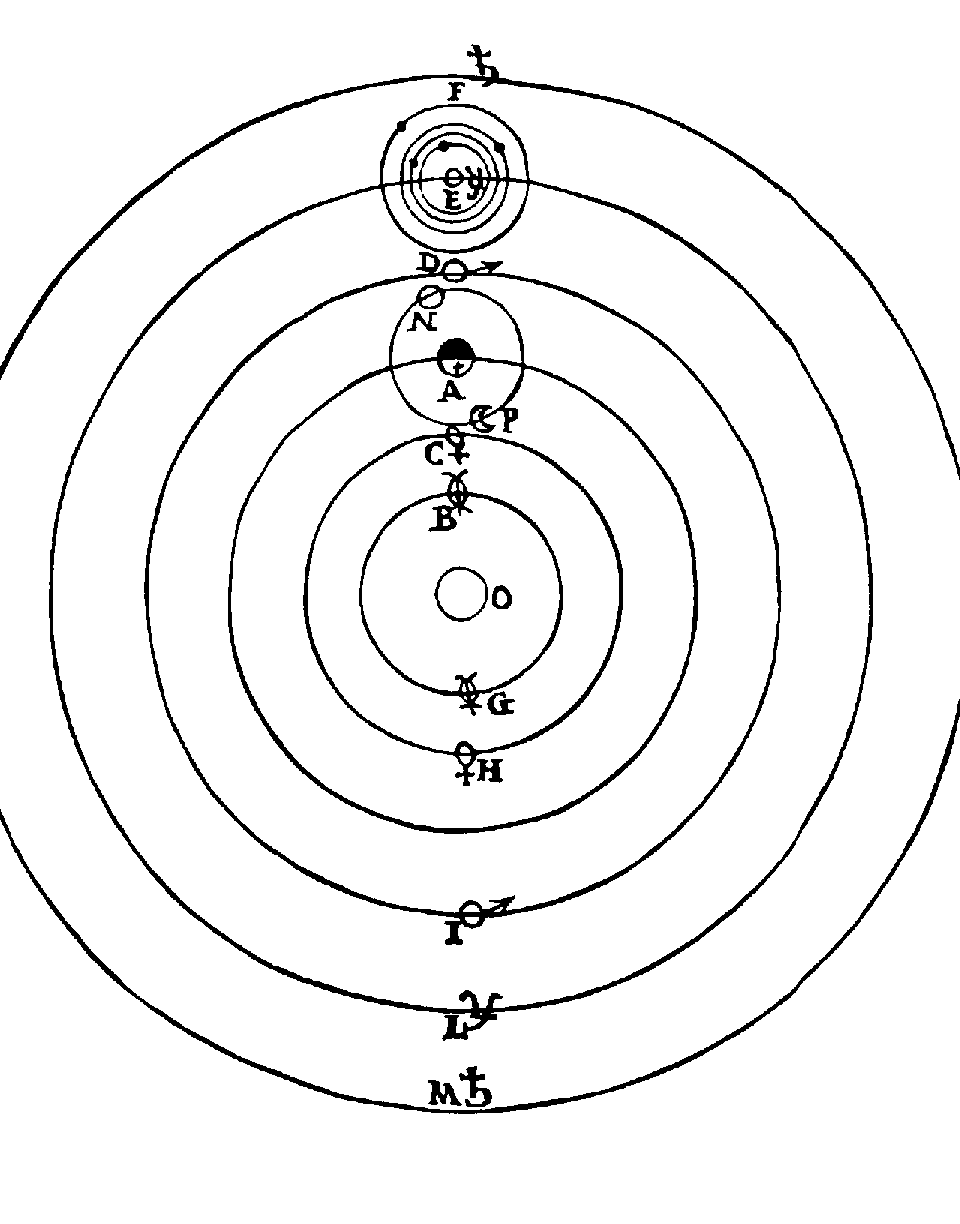
My model is heavily based off the Copernicus model, a heliocentric model. In my model, the sun is in the middle, and the planets orbit around it.
Diary entry 1
Dear Diary,
I'm Galileo Galilei, and I was born on February 15, 1564. Born in Pisa, Italy, I consider myself an intelligent being with extensive knowledge of how the universe would look like. Over my lifetime, I have delved into many fields, including engineering, physics, astronomy and mathematics. I have been given the status of "The father of observational astronomy" over the course of my career. During this career, I have also discovered the 4 largest satellites of Jupiter (Which I call the Galilean moon), the phases of Venus, and the observation of sunspots. I have a perfect theory of how the universe looks like, through scientific observation with my telescope. This scientific instrument provides clear evidence of my theory.

I'm Galileo Galilei, and I was born on February 15, 1564. Born in Pisa, Italy, I consider myself an intelligent being with extensive knowledge of how the universe would look like. Over my lifetime, I have delved into many fields, including engineering, physics, astronomy and mathematics. I have been given the status of "The father of observational astronomy" over the course of my career. During this career, I have also discovered the 4 largest satellites of Jupiter (Which I call the Galilean moon), the phases of Venus, and the observation of sunspots. I have a perfect theory of how the universe looks like, through scientific observation with my telescope. This scientific instrument provides clear evidence of my theory.
Subscribe to:
Comments (Atom)